Senior Electrician Salary in Los Angeles, CA: $134,472 (2026)
Quick Answer:The top tier of electricians working in Los Angeles, CA — those at or above the 90th percentile — pull in $134,472/year or more for 2026, based on BLS OEWS 2025 estimates for SOC 47-2111. Strip back Los Angeles's price premium (BEA RPP 113.6, 14% above national) and that top-decile pay carries the same buying power as $118,409 in average-cost America. The 78% spread above city median typically rewards 7+ years of practice or specialty credentials.
Official BLS data · View source
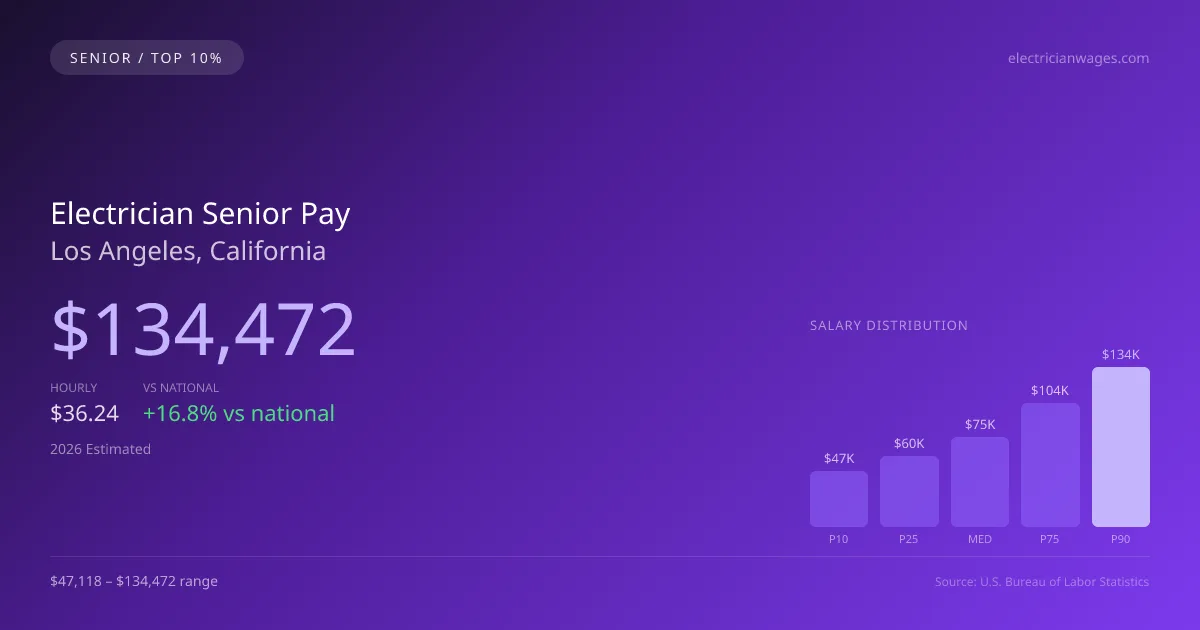
In Los Angeles, the potential for seasoned electricians to significantly enhance their earnings is substantial. The 2026 projected median annual salary for experienced electricians stands at $75,375, yet top earners can make an impressive $134,472. This gap illustrates the premium that comes with extensive experience and skill, particularly for those reaching the 90th percentile of earnings. Professionals looking to command such salaries often find success through specialization, skills development, and a deep understanding of advanced electrical systems. Competing in this competitive market means staying ahead with updated certifications and industry insight, ultimately allowing a small percentage of electricians to secure a place in the upper echelons of the pay scale. By developing niche expertise in areas like industrial controls or renewable energy, electricians can dramatically increase their earning potential compared to the national median of $64,530.
2026 Salary Percentile Distribution in Los Angeles
Experienced electricians at the top of the pay scale in Los Angeles earn between $104,091 and $134,472 per year (2026 est.). This $87,354 range from 10th to 90th percentile reflects significant earnings potential growth over a career. The Los Angeles median of $75,375 sits 16.81% above the US median.
Top ELEC Salary Comparison
| Level | Los Angeles | National |
|---|---|---|
| Median (P50) | $75,375 | $64,530 |
| 75th Percentile | $104,091 | $85,720 |
| 90th Percentile (Top 10%) | $134,472 | $110,810 |
In Los Angeles, experienced electricians (P90) earn 78.40% more than the local median — reflecting the significant value of specialization and tenure in this market.
What Drives Top Electrician Pay in Los Angeles
Advanced Certifications in California
CA electricians with additional specialty certifications within the electrical field earn significantly above the $75,375 median. Expanded-scope credentials are increasingly valued by Los Angeles employers.
Specialty Focus
Electricians focusing on high-acuity or specialty areas within the electrical field in Los Angeles command premium compensation, often reaching the $104,091–$134,472 range.
Large Health-System & Multi-Site Experience
Large hospital systems and multi-site employers in the Los Angeles metro area, which is a large ELEC employment market, often pay above-market rates for experienced electricians who demonstrate efficiency and leadership.
Employer Loyalty & Patient Relationships
Long-tenured electricians in Los Angeles with established relationships have strong negotiating leverage. In this competitive market, retention bonuses and annual raises are common for top performers.
Continuing Education & Leadership
Electricians in California who pursue advanced degrees, mentor junior staff, or lead clinical education programs position themselves for the highest compensation tiers and management roles.
Electrician Career & Wage Growth Path in Los Angeles
Clinical Electrician
0-5 yearsSenior/Lead Electrician
5-10 yearsElectrician Department Manager
10+ yearsEducator / Specialty Leadership
AdvancedLos Angeles ranks #18 of 158 California cities for top earner electrician salary (90th percentile: $134,472).
Top 10% electrician compensation in Los Angeles ($134,472) is 6.03% below the California average P90 ($143,103).
2019 BLS Actual
$103,690
2025 BLS Actual
$131,680
2026 Current Est.
$134,472
2019–2027 Growth
+32.4%
Salary Trajectory for Electricians in Los Angeles (2019–2027)
2019–2025: actual BLS OEWS data for this metro area. 2026+: CAGR 2.12% projection.
| Year | Annual Salary | Status |
|---|---|---|
| 2019 | $103,690 | Actual |
| 2020 | $114,780 | Actual |
| 2021 | $104,670 | Actual |
| 2022 | $119,390 | Actual |
| 2023 | $130,790 | Actual |
| 2024 | $128,400 | Actual |
| 2025 | $131,680 | Actual |
| 2026(current) | $134,472 | Estimated |
| 2027 | $137,322 | Projected |
Top-earning electricians (90th percentile) in Los Angeles saw their compensation grow 27.0% from $103,690 in 2019 to $131,680 in 2025, based on 7 years of BLS OEWS data for this metropolitan area. At a 2.12% annual growth rate, senior-level pay is projected to reach $137,322 by 2027, reflecting continued demand for clinical expertise and expanded-function credentials.
Note: Historical values (2019–2025) are actual BLS OEWS figures for the Los Angeles metropolitan area, sourced from annual Occupational Employment and Wage Statistics surveys. 2026–2026 figures are current estimates, and 2027 values are projections, calculated using a 2.12% CAGR derived from 7-year BLS historical data. Actual salaries may vary based on employer, experience, certifications, and local market conditions.
Maximizing Your Electrician Earnings in Los Angeles
The landscape in Los Angeles for senior electricians shows that specialization in critical areas can significantly influence pay. Electricians with expertise in industrial controls, PLC programming, and fire alarm systems often see compensation packages that outpace conventional residential roles. The type of employer also impacts pay; union electricians working with IBEW often receive 30-50% higher wages compared to their non-union counterparts due to comprehensive benefits and pension plans. Additionally, emerging fields like solar PV and EV charging installations continue to drive demand for skilled electricians, pushing compensation higher in these sectors. The progression path for seasoned electricians can lead from journeyman status to master electrician or even business owner, with advanced credentials enhancing their competitive edge. Obtaining a master electrician license or state electrical contractor license after a thorough apprenticeship lays the groundwork for increased financial rewards. Furthermore, the appeal of overtime opportunities and evolving job specialties further incentivizes investments in education and training, making Los Angeles a pivotal area for high-caliber electrical professionals.
More salary data for Los Angeles, CA:
Frequently Asked Questions
How much do experienced electricians make in Los Angeles in 2026?
What drives higher electrician pay in Los Angeles?
What certifications boost electrician salary in Los Angeles?
Can experienced electricians make six figures in Los Angeles?
How much does electrician salary increase over time in Los Angeles?
Related Pages
Compare Salaries
Career Resources
Nearby Cities in California
Written by Samuel Carter, Career Analyst
Career Analyst
Samuel Carter has over 10 years of experience as an electrician. His focus includes residential wiring and safety standards. He has worked in various construction firms.
Methodology & Data Source
Top-earner salary figures on this page are 2026 projections derived from the Bureau of Labor Statistics Occupational Employment and Wage Statistics (OEWS) survey, May 2026 release. BLS reported a 90th percentile salary of $131,680 for electricians in the Los Angeles metro area. A 2.12% compound annual growth rate (CAGR), calculated from 6-year national BLS wage trends, was applied to project current 2026 senior-level compensation. Individual earnings depend on certifications, specialization, practice type, and years of clinical experience.
Data Sources & Methodology
Source: BLS, OEWS, 7-year dataset (–). Per-city data from annual BLS metropolitan area surveys.
2026 figures are projected from 2025 BLS data using a compound annual growth rate (CAGR) of 2.12%, derived from historical BLS wage trends for electricians (SOC 47-2111).
Compiled and verified by Samuel Carter, Career Analyst, a licensed electrician with 10+ years of clinical experience. · View source data at BLS.gov